The short answer
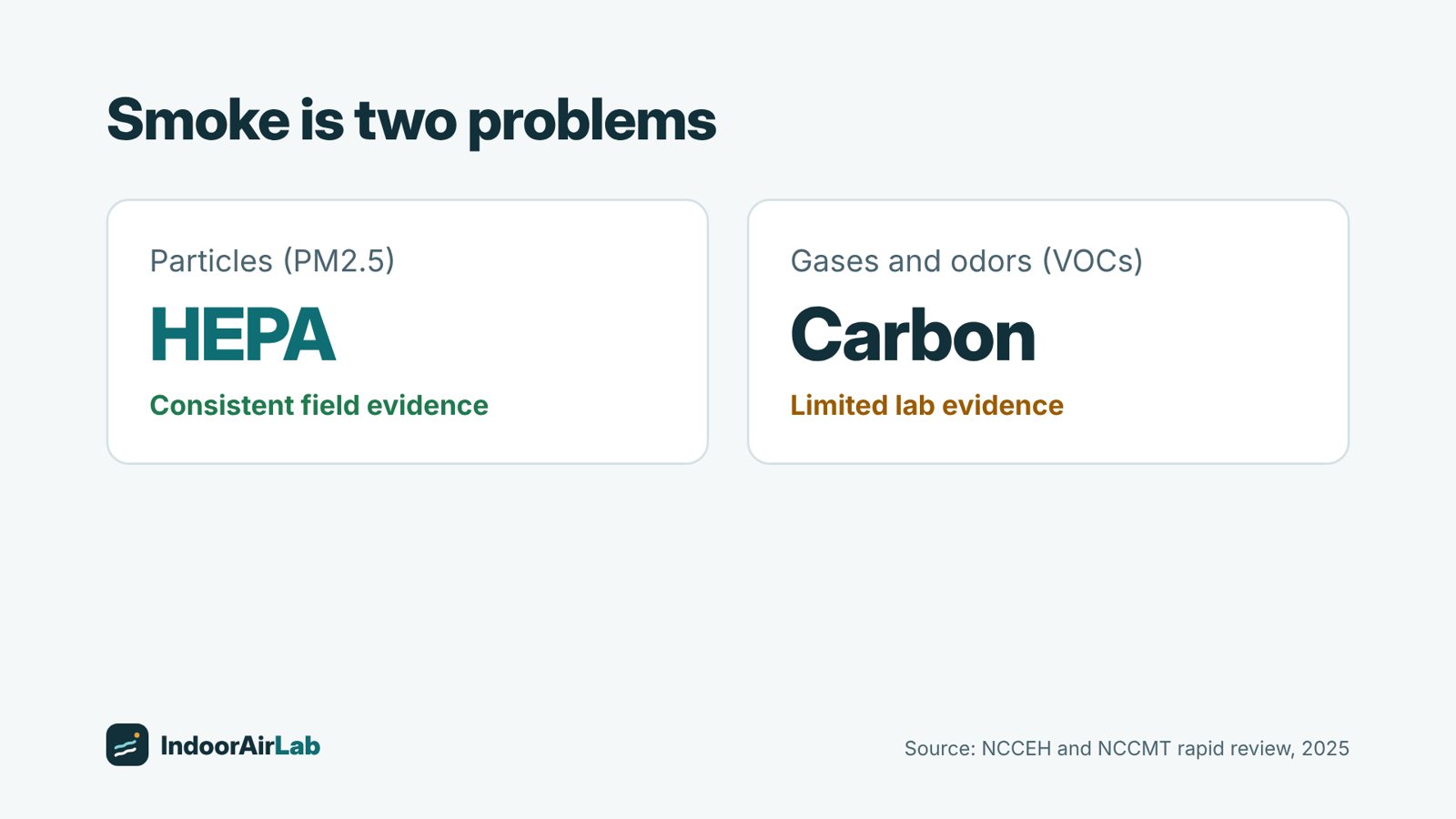
Wildfire smoke is two problems at once: fine particles and gases. A HEPA filter handles the particles. Activated carbon is the only filter type with research support for reducing smoke gases, but that evidence is limited and inconsistent, and how much carbon a unit contains matters. If your main concern is the health effect of smoke particles, HEPA is the essential part.
Particles vs. gases
| Particles (PM2.5) | Gases and odors (VOCs) | |
|---|---|---|
| What it is | Tiny solid and liquid specks of burned material | Chemical vapors such as benzene, toluene, and formaldehyde |
| Filter that targets it | HEPA | Activated carbon or other sorbents |
| Strength of evidence | Reasonably consistent across field studies | Very low certainty; few studies |
What HEPA does
A true HEPA filter is built to capture at least 99.97% of particles at 0.3 microns, the size that is hardest to trap. That covers the PM2.5 range that makes wildfire smoke harmful. In field studies during real smoke events, portable air cleaners reduced indoor PM2.5 by about 56% on average (see Do air purifiers work for wildfire smoke?).
What activated carbon does
Activated carbon works by adsorption: gas molecules stick to its porous surface. In the 2025 NCCEH review of indoor air filtration during smoke episodes:
- The reviewers found insufficient evidence to say how well filtration reduces gases, and rated the certainty very low.
- In two lab studies of smoke VOCs, only devices with activated carbon filters reduced VOC levels, and results were inconsistent between studies.
- One chamber study found 4 of 6 commercial purifiers combining HEPA and charcoal filtered benzene and toluene effectively. Another study of a purifier with HEPA, carbon, and an ionizer saw formaldehyde fall by only about 3% after smoke was injected.
In short, carbon can help, but the results depend heavily on the specific product and test.
Why the amount of carbon matters
Carbon filters fill up. A 2022 modeling study in Chemosphere found that the quantity of activated carbon is critical to getting a reasonable filter lifetime. A thin carbon-coated sheet will saturate quickly, so it may do little after a few days of heavy smoke. A thick bed with more carbon lasts longer but usually adds weight and cost.
There is no established minimum carbon weight for smoke. When comparing models, look for the actual carbon weight in the specifications. A listing that only says carbon-infused or carbon-treated tells you little.
Be careful with marketing claims
Many manufacturer pages claim that their units remove more than 95% of smoke gases, or that a purifier needs pounds of carbon to be effective. Those figures come from the companies, not from independent peer-reviewed work, and the NCCEH reviewers did not find high-quality field research on gases during wildfires. Treat vendor numbers as a starting point to verify.
What about ionizers and ozone?
In one chamber study, purifiers with ionizing technology performed about as well as HEPA-plus-carbon units on pine-needle smoke particles. But some air cleaners generate ozone, a lung irritant, and the EPA advises caution about harmful by-products. For smoke, a mechanical filter is the safer choice.
What to buy
- Always: a true HEPA filter with a smoke CADR that fits your room (see our sizing guide).
- If odor and gases bother you: add a unit with a substantial, clearly stated amount of activated carbon, and expect to replace the carbon filter more often during smoke season.
- If your budget is tight: put the money into more HEPA airflow first. The particle evidence is stronger.
What we will test next
We plan to measure how much carbon each model contains and how it performs over time. We will add our findings here when they are done.
Sources
- NCCEH and NCCMT. Indoor air filtration during wildfires: Impacts on air quality and health (2025). ncceh.ca
- Maximoff SN, et al. Performance evaluation of activated carbon sorbents for indoor air purification during normal and wildfire events. Chemosphere 304:135314 (2022).
- Stinson BW, Laguerre A, Gall ET. Particle and gas-phase evaluation of air cleaners under indoor wildfire smoke conditions. ACS ES&T Air 1(6):492-501 (2024).
- U.S. EPA. Research on DIY air cleaners to reduce wildfire smoke indoors (notes ongoing EPA work on commercial air cleaners and smoke VOCs). epa.gov