The short answer
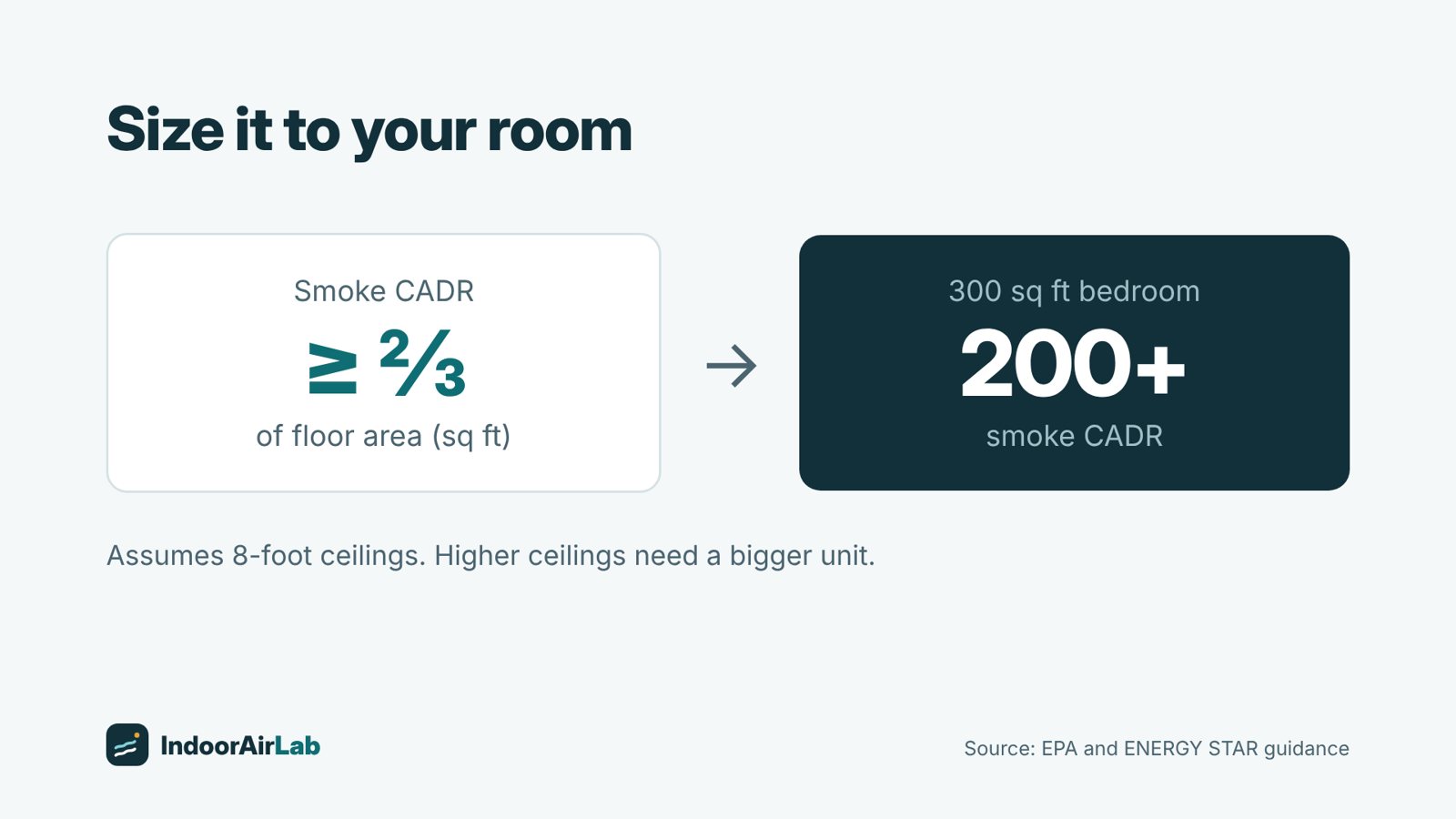
Measure your room's floor area in square feet, then pick a purifier whose smoke CADR is at least two-thirds of that number. That is the minimum recommended by ENERGY STAR and the EPA for a room with 8-foot ceilings. During heavy smoke, many manufacturers and industry guidance aim higher, closer to a smoke CADR equal to the room's area.
What CADR means
CADR is the clean air delivery rate: how many cubic feet of filtered air a purifier delivers per minute. Units tested to the AHAM standard get three CADR numbers, for smoke, dust, and pollen. For wildfire smoke, use the smoke number. Smoke particles are smaller than dust and pollen, so the smoke figure is usually the lowest of the three.
Health Canada also advises checking the CADR and suggested room size on the AHAM label when choosing a purifier.
The sizing table
| Room size | Minimum smoke CADR (two-thirds rule) | Higher target for heavy smoke (about 1x area) |
|---|---|---|
| 120 sq ft (10 x 12 ft) | 80 | 120 |
| 150 sq ft | 100 | 150 |
| 300 sq ft | 200 | 300 |
| 450 sq ft | 300 | 450 |
| 600 sq ft | 400 | 600 |
The 120 sq ft example with a smoke CADR of 80 comes from EPA guidance. The higher-target column reflects AHAM's wildfire recommendation as reported by industry sources, so treat it as a conservative option rather than a requirement.
If your ceilings are higher than 8 feet, you need a larger unit, because there is more air to clean.
Why the box size claim is not enough
The room size printed on a purifier's box is based on a manufacturer's assumptions about how many times per hour the unit should replace the room's air. Those assumptions differ between brands, so box ratings are hard to compare. The smoke CADR is a tested number you can check against the same rule every time.
A bigger CADR than the minimum is not wasted. A stronger unit cleans the air faster, and it can run at a lower, quieter speed.
Other things that matter
- Run it continuously. EPA's cleaner-air-room guidance, as summarized by third parties, recommends running the purifier as much as possible, on the highest setting you can tolerate.
- Choose a CARB-certified model. California Air Resources Board certification limits ozone emissions, which is a concern with some air cleaners.
- Think about noise. The best purifier is one you will actually leave running. In an EPA field pilot, noise was the main reason people did not run louder DIY units.
- Stay in one room. A purifier is sized for a single room. Pick the room where you sleep or spend most of your time, and keep its door and windows closed.
Use our calculator
On the IndoorAirLab homepage, set your room size and see which purifiers cover it, along with their air changes per hour and five-year cost.
Sources
- ENERGY STAR. An air cleaner can be helpful in high-risk wildfire areas. energystar.gov
- Health Canada. Choosing a portable air purifier. canada.ca
- NCCEH and NCCMT. Indoor air filtration during wildfires: Impacts on air quality and health (2025). ncceh.ca
- U.S. EPA. Indoor air filtration and Create a clean room to protect indoor air quality during a wildfire (epa.gov).
- AHAM (Association of Home Appliance Manufacturers) guidance on air cleaners and wildfire smoke (aham.org).